

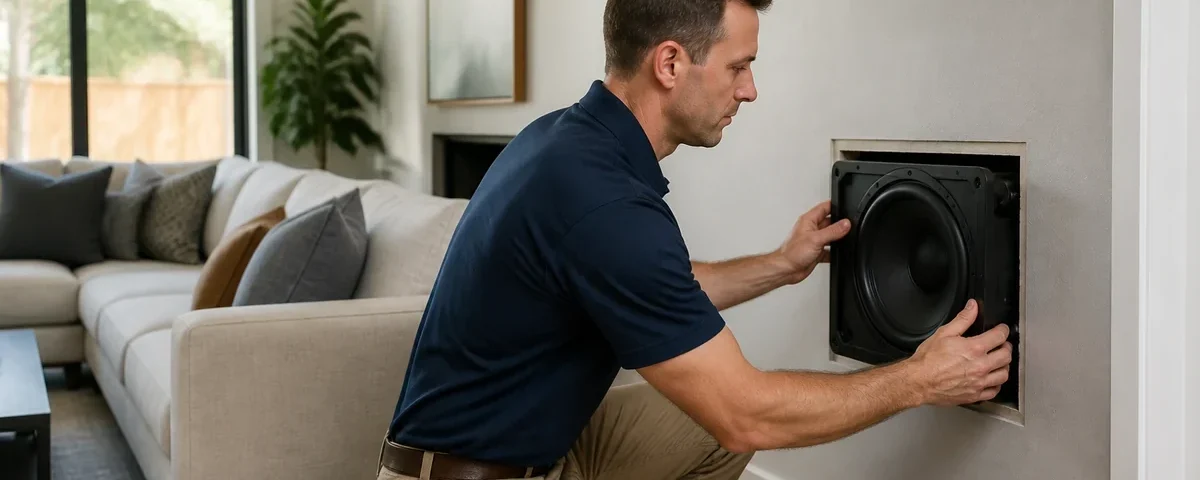
Written by Diego Hernandez · AMX Designer | Savant Programmer | Harman Pro Certified
Every Houston homeowner we talk to wants the same thing from their media room: movie night that actually feels like a theater, game day that shakes the couch a little, and music that sounds full instead of tinny. The missing piece is almost always bass. An in wall subwoofer installation Houston families choose hides the subwoofer inside a wall, keeps the floor clear, and pairs with a subwoofer amp that delivers clean, punchy low end without a giant black box in the corner. This guide covers how hidden bass works, which rooms benefit most, and what to expect from a professional install across Houston, Sugar Land, Katy, and The Woodlands.
Why In Wall Subwoofers Make Sense for Houston Homes
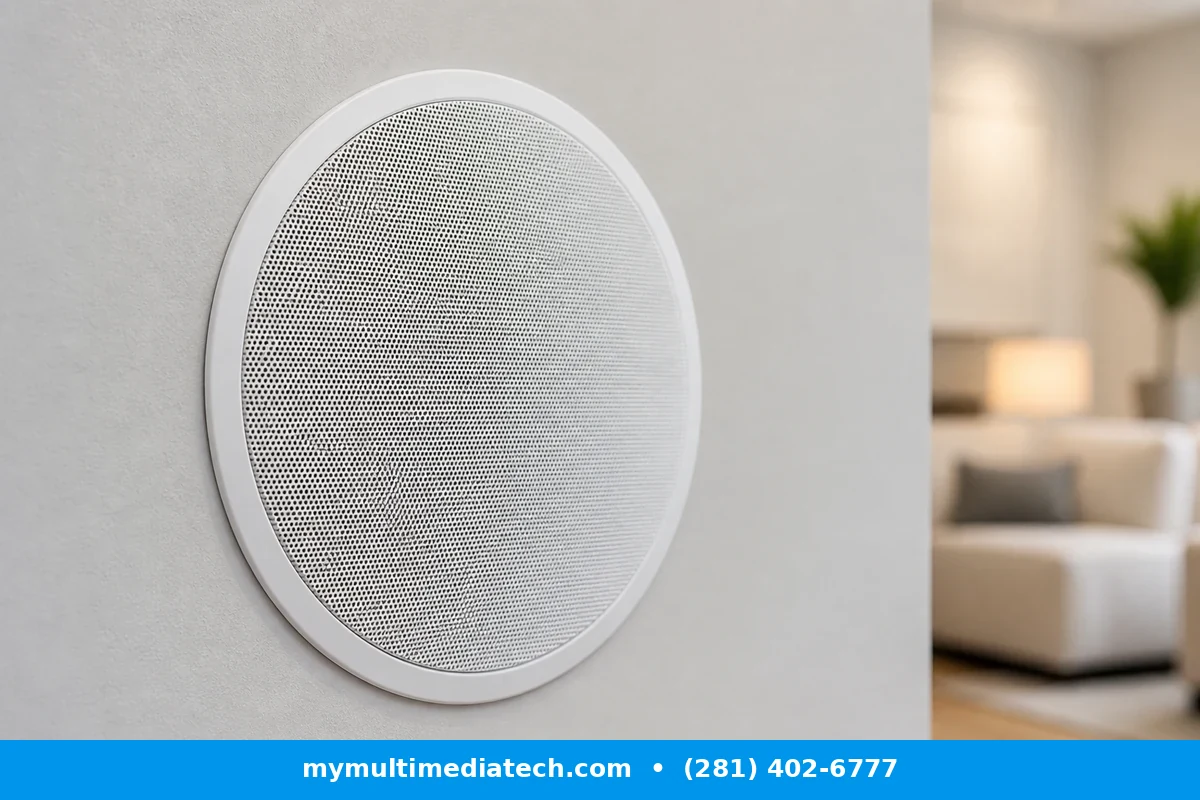
Houston homes are built around open floor plans. The kitchen flows into the family room, the family room opens to the patio, and sound travels everywhere. A traditional subwoofer cabinet works, but it takes up floor space, becomes a magnet for toys and dog beds, and rarely matches the furniture. An in wall subwoofer disappears behind a grille that can be painted to match the wall.
The other Houston-specific factor is humidity. Subwoofers sitting on the floor in a slab-built home are closer to moisture and dust. In wall subwoofers mount higher in the wall cavity, away from the floor, which keeps them cleaner and less exposed. For families in Sugar Land, Katy, Cypress, and The Woodlands, the flush mount also means one less thing for kids and pets to knock over.
How In Wall Subwoofer Installation Houston Works
A professional in wall subwoofer installation Houston homeowners can rely on follows a clear sequence:
- Choose the location. The installer finds a wall cavity that opens into the main listening area. Corner placements add output; wall-center placements sound more even. We map this before cutting anything.
- Cut the opening. A template marks the cut. The installer checks for studs, pipes, and wiring inside the cavity before making the first cut.
- Install the rough-in or back box. The subwoofer mounts into a structural frame that keeps it rigid. Rigid mounting matters: a loose subwoofer rattles and buzzes at high output.
- Run the wire. Low voltage speaker wire runs from the subwoofer amp to the driver, usually through the wall and attic. CL2 or CL3 rated in-wall cable is required.
- Mount the driver and grille. The subwoofer secures into the frame, the grille snaps on, and the install becomes invisible.
- Tune the amp. The subwoofer amp’s crossover, gain, and phase are set to blend with the room’s main speakers. This step is what separates a great install from a mediocre one.
The whole process for a single subwoofer takes most of a day, including the drywall work and cleanup. Most Houston homes can have hidden bass before dinner.
Choosing the Right Subwoofer Amp
The subwoofer amp is the quiet hero of an in wall subwoofer system. It takes the bass signal from the receiver or processor and powers the driver with controlled, clean wattage. What to look for:
- Enough power for the room. A 10-inch in wall subwoofer typically wants 200-400 watts. Bigger rooms and bigger drivers want more.
- A built-in crossover. The amp should send only the low frequencies (usually below 80 Hz) to the subwoofer and leave the mids and highs to the main speakers.
- Phase control. This lets the installer align the subwoofer’s output with the main speakers so the bass arrives at the same time.
- Compact form factor. Most subwoofer amps are small enough to mount on a wall near the subwoofer or tuck into a media closet.
Brands we install regularly include KEF for their precision engineering and Martin Logan for architectural bass that sounds effortless. Sonance and Klipsch also make solid in wall subwoofer options for different budgets. The right pick depends on your room size and how loud you want the low end to go.
Which Rooms Benefit Most
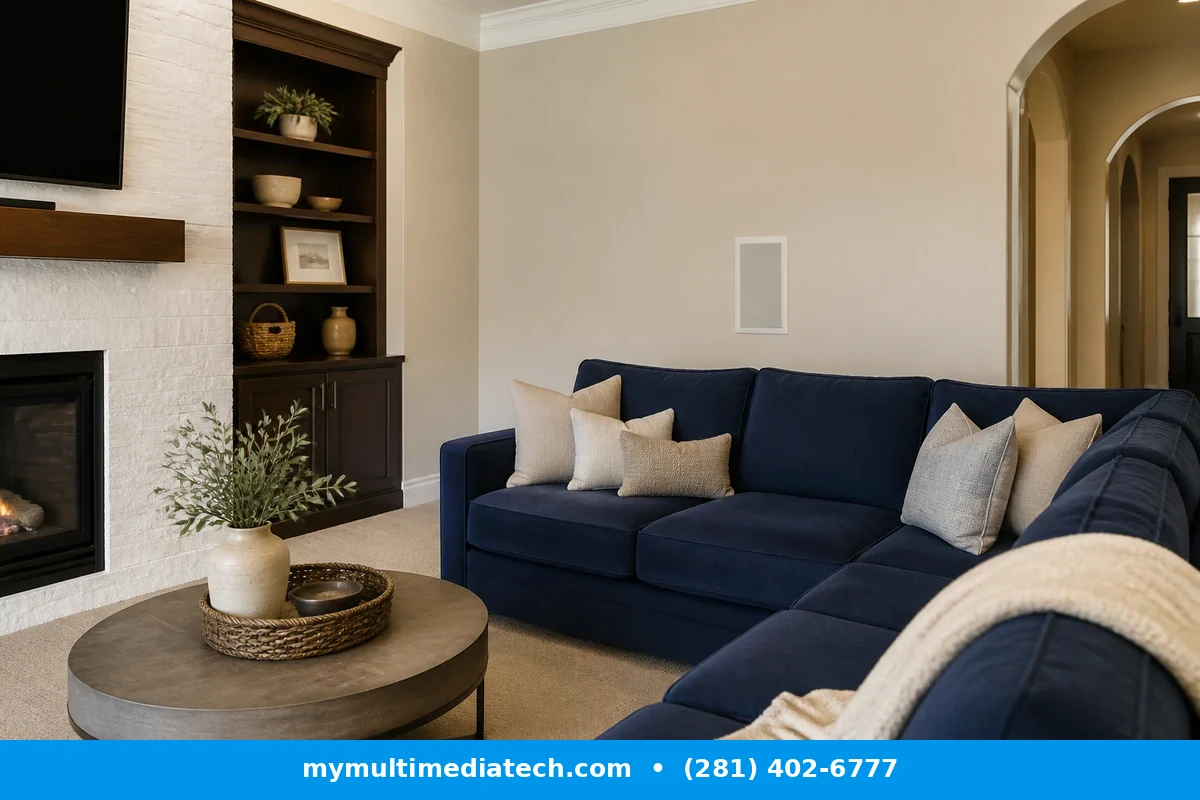
Media rooms and family rooms: This is the classic use. A 5.1 or 5.1.2 surround system with in wall subwoofer installation Houston families choose delivers the movie experience without a visible subwoofer. We pair it with in wall or in ceiling speakers for a fully hidden system.
Primary bedrooms: More couples are adding a TV and sound system to the primary suite. An in wall subwoofer behind the TV wall gives the room bass without a cabinet in the walkway.
Game rooms: Kids’ game rooms get a lot of abuse. Hidden speakers and subwoofers survive better than floor-standing gear, and they keep the room flexible for furniture changes.
Whole-home audio systems: For background music in a kitchen or living area, an in wall subwoofer adds warmth that ceiling speakers alone cannot deliver. It works with a Sonos Amp or a traditional receiver, and it makes the whole house feel more complete.
Home offices doubling as media spaces: Houston has a lot of work-from-home setups now. A hidden subwoofer gives video calls and music a fuller sound without looking like an office electronics store.
In Wall Subwoofer vs. Traditional Subwoofer
| Factor | In wall subwoofer | Traditional subwoofer | |—|—|—| | Floor space | None, mounts in wall | Takes up 1-2 square feet | | Visibility | Invisible with grille | Always visible | | Bass output | Great for most rooms | Higher output for huge rooms | | Installation | Professional install required | Can be placed by owner | | Aesthetics | Matches the wall | Rarely matches furniture |
For 90% of Houston homes, an in wall subwoofer is the better choice. The exception is a dedicated, acoustically treated theater room where maximum output matters more than aesthetics. In that case we often recommend a hybrid: in wall subwoofers for the main bass plus a sealed cabinet for the deepest effects.
What It Costs in the Houston Area
Rough 2026 pricing for a hidden subwoofer setup Houston homeowners can expect:
- 10-inch in wall subwoofer with amp: $700-$1,200 in parts
- 12-inch in wall subwoofer with amp: $1,000-$1,600 in parts
- Labor for cut, mount, wiring, and tuning: $400-$800
- Full 5.1 system with hidden subwoofer: $2,500-$5,500 installed
Most Houston families land between $1,200 and $2,000 for a single hidden subwoofer with professional installation. That includes the amp, the drywall work, and the calibration that makes it sound right.
Common Mistakes DIYers Make
Cutting into a wall cavity with obstructions. Pipes, studs, and existing wiring hide behind drywall. We always verify the cavity with a scope or careful probing before cutting.
Under-powering the subwoofer. A subwoofer amp that is too small clips at high volume, and clipping kills drivers. Match the amp to the driver’s continuous rating with headroom to spare.
Skipping the back box. Without a proper enclosure, an in wall subwoofer sounds muddy and vibrates the wall. The back box is not optional.
Wrong crossover settings. If the subwoofer plays frequencies above its range, the bass sounds boomy and the main speakers sound thin. An 80 Hz crossover with proper slope fixes both problems.
Forgetting the room. A media room with a lot of windows and hard floors behaves differently than a carpeted, curtained room. Calibration on-site is the only way to get it right. Our room acoustics guide explains the basics in plain language, and our Dolby Atmos setup guide covers how hidden bass fits a full surround system.
Frequently Asked Questions
Can an in wall subwoofer really deliver theater-quality bass?
Yes, in most rooms. A properly installed 10 or 12-inch in wall subwoofer with a matched amp delivers the 20-80 Hz range that makes movies feel cinematic. The output is comparable to a good sealed cabinet subwoofer. Only very large, dedicated theater rooms need more.
Do I need a subwoofer amp, or does my receiver do it?
Your receiver sends the bass signal, but a dedicated subwoofer amp provides the power and the crossover control. Some receivers have a built-in subwoofer output that feeds an external amp. The external amp is what actually drives the in wall driver. You need both.
Can you add an in wall subwoofer to an existing media room?
Yes. Adding a subwoofer to an existing room is one of the easiest audio upgrades we do. We cut the opening, run the wire, mount the amp, and tune the system. Most existing rooms have a wall cavity that works. We cover this type of work across Houston, Sugar Land, Katy, Cypress, Tomball, and Spring.
How loud can in wall subwoofers get?
A good 12-inch in wall subwoofer can reach 110 dB or more at listening positions, which is enough for home theater reference levels in typical Houston media rooms. For neighbors and shared walls, we set sane limits and add isolation where needed.
Will an in wall subwoofer work with my Sonos system?
Yes. Sonos Amp and Sonos systems with a sub output can drive an in wall subwoofer through a compatible amp. We configure the crossover in the Sonos app and the subwoofer amp together. It is a clean way to add bass to a whole-home audio setup.
How long does installation take?
A single subwoofer install takes most of a day, including drywall work, wiring, and calibration. A full 5.1 system with in wall subwoofer typically takes one to two days. We schedule around your family’s routine.
Ready for Hidden Bass in Your Houston Home?
An in wall subwoofer installation Houston families love starts with a free in-home walkthrough. We measure the room, pick the wall cavity, and give you a straight quote in writing. Most installs finish in a day.
Diego Hernandez is the lead AV systems designer at Multimedia Tech, with certifications from AMX, Savant, Harman Pro Audio (AKG, BSS, Crown, dbx, JBL Pro), and full manufacturer training in audio, video, control, networking, lighting, and cabling systems. He designs residential AV across Greater Houston.
Book your home theater installation or call us at (281) 402-6777. Serving Houston, Sugar Land, Katy, The Woodlands, and Cypress. Find us on Google.