
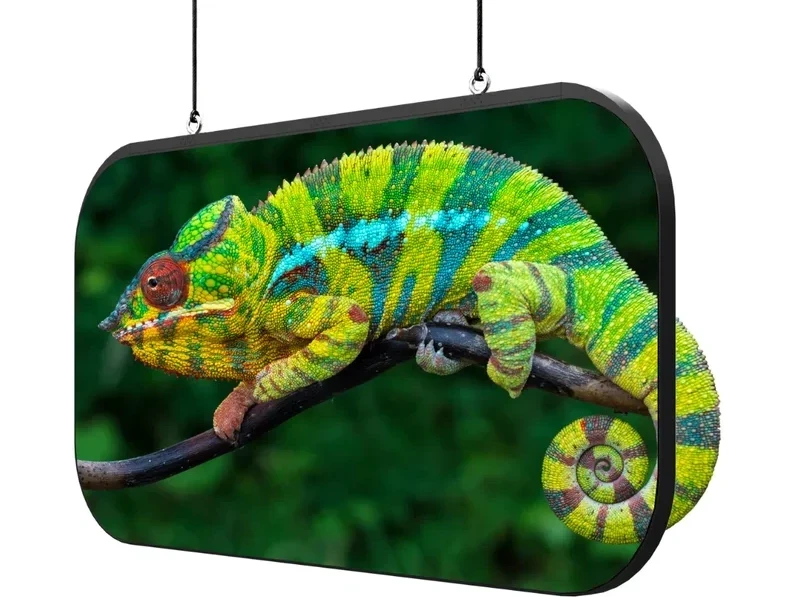
A double-sided LED video wall is exactly what it sounds like: one slim LED panel that shows content on both of its faces. You see these most often in storefronts, hotel lobbies, and airport concourses, where foot traffic approaches from two directions at once. One fixture, one power drop, two faces showing at the same time.
How the Planar Chameleon Series Works
The Planar Chameleon Series is a double-sided LED video wall built around a cabinet that is under two inches deep (45 mm). It ships in 500 x 500 mm modules with rounded or 90-degree corners, so installers can build straight runs, columns, or curved corners from the same hardware.
Each face is independent. A double-sided LED video wall can show a brand message to the street while the inward face shows directions, a menu, or a schedule to people already inside. When a single message needs to wrap the whole fixture, both sides can stay locked together instead.
Why Two Sides Beat Two Screens
The obvious benefit of a double-sided LED video wall is density. One cabinet does the job of two separate single-sided signs, which cuts mounting hardware, power runs, and cabling. That is simpler to install and simpler to maintain over the life of the display.
The slim profile is the second big advantage. At 45 mm deep, a double-sided LED video wall reads as a clean glass divider rather than a heavy kiosk, which is why it fits retail windows, reception desks, and narrow concourse walkways.
Brightness and Serviceability
High-brightness models reach up to 3,000 nits, enough to stay legible in a sunlit storefront or a glass atrium. The cabinets are front-serviceable and lightweight, so a technician can reach the display from the front without tearing the whole wall apart, and the finished protective trim keeps the edges clean.
Planar builds the Chameleon Series for continuous use, and the Planar Chameleon Series product page carries the full specification sheet.
Is This the Right Display for You?
A double-sided LED video wall is a commercial digital signage product first, so it is a different purchase from a living-room TV. If you run a business, restaurant, or public space in the Greater Houston area, this is the kind of display that pulls double duty and lasts for years. For residential spaces, the same premium direct-view LED technology shows up in single-sided video walls and large-format displays that we install as part of home theater installation.
For more on choosing and sizing large displays, see our TV size and viewing distance guide and our TV mount selection guide.
Double-Sided vs Single-Sided
A single-sided LED display points one direction and ignores everyone walking the other way. A two-sided panel doubles the reach without doubling the footprint, because both faces share the same cabinet, the same power feed, and the same content player. In a corridor or a storefront, that is the difference between a sign that works for half the room and one that works for the whole room.
The trade-off is that a two-sided cabinet costs more than a single-sided module of the same pixel pitch, so the math only makes sense where foot traffic genuinely approaches from two directions. For a storefront window or a reception desk, the second side usually pays for itself. For a wall-mounted display facing a single seating area, a single-sided display is usually the right call.
Key Specifications at a Glance
- Form factor: double-sided LED, under two inches deep (45 mm)
- Cabinet: 500 x 500 mm, with rounded or 90-degree corners
- Brightness: up to 3,000 nits on high-brightness models
- Content: independent or synchronized dual-sided playback
- Service: front-serviceable, lightweight cabinets
- Finish: finished protective trim for clean public edges
What to Look at Before You Buy
- Pixel pitch. A finer pitch (a smaller number) means a sharper image at close viewing distance. Tighter pitches suit lobbies and retail; coarser pitches work for longer viewing distances.
- Mounting. Suspended, floor-standing, and wall options all exist. Suspended two-sided displays are common in corridors and above reception desks.
- Content management. Plan for a system that can push different content to each face, or lock both faces together when needed.
- Service access. The Chameleon Series is front-serviceable, which matters in a narrow storefront where rear access is not realistic.
- Power and network. Both faces share one feed, but a large display still needs proper power and a stable network drop for remote content updates.
Why Choose Planar
Planar has spent years building direct-view LED for demanding signage, and the Chameleon Series brings that same engineering to a two-sided form factor. The under-two-inch depth, the rounded corner option, and the front-serviceable cabinets all point to a product designed for real installs rather than a spec sheet.
If you are weighing a two-sided display against a single-sided video wall or a large-format TV, we can help you decide.
The Bottom Line
A double-sided LED video wall is one of the highest-impact ways to reach people moving in both directions, and the Planar Chameleon Series is the current benchmark for slim, bright, dual-sided signage. With 15,000+ completed projects behind us, we can help you decide whether a two-sided display, a single-sided video wall, or a large-format TV is the right fit for your space.
Talk to us about your premium display project, and we will walk you through the options.